The Tension Nobody’s Naming
Here is a paradox worth sitting with. The organisations racing hardest to cut headcount with AI are quietly erasing the very judgement, problem framing and oversight that make AI outputs worth acting on.
Automation rarely fails because the model is weak. It fails because the human layer around it has been hollowed out. Remove the person who spots the bad assumption, and you do not get efficiency. You get confident errors at scale.
As routine cognitive work gets commoditised, your competitive edge shifts. It is no longer speed or volume. It is the quality of thinking AI cannot do for you: framing the ambiguous problem, spotting the subtle flaw, negotiating the contested outcome, and taking accountability when no algorithm can.
A Simple Filter
Most leadership teams are asking the wrong question.
They ask: What can we automate? The sharper question is: Does this skill solve a problem that AI creates, or one that AI removes?
If it is the latter (faster drafting, quicker summaries, automated coding), you are investing in a depreciating asset. The next model release will absorb that task. If it is the former (discerning whether a draft is true, deciding if a summary misses the political nuance, knowing when to ignore the generated code and rewrite the architecture), you are building something that gets more valuable the cheaper AI becomes.
That distinction is the difference between a workforce that uses AI and one that is genuinely augmented by it.
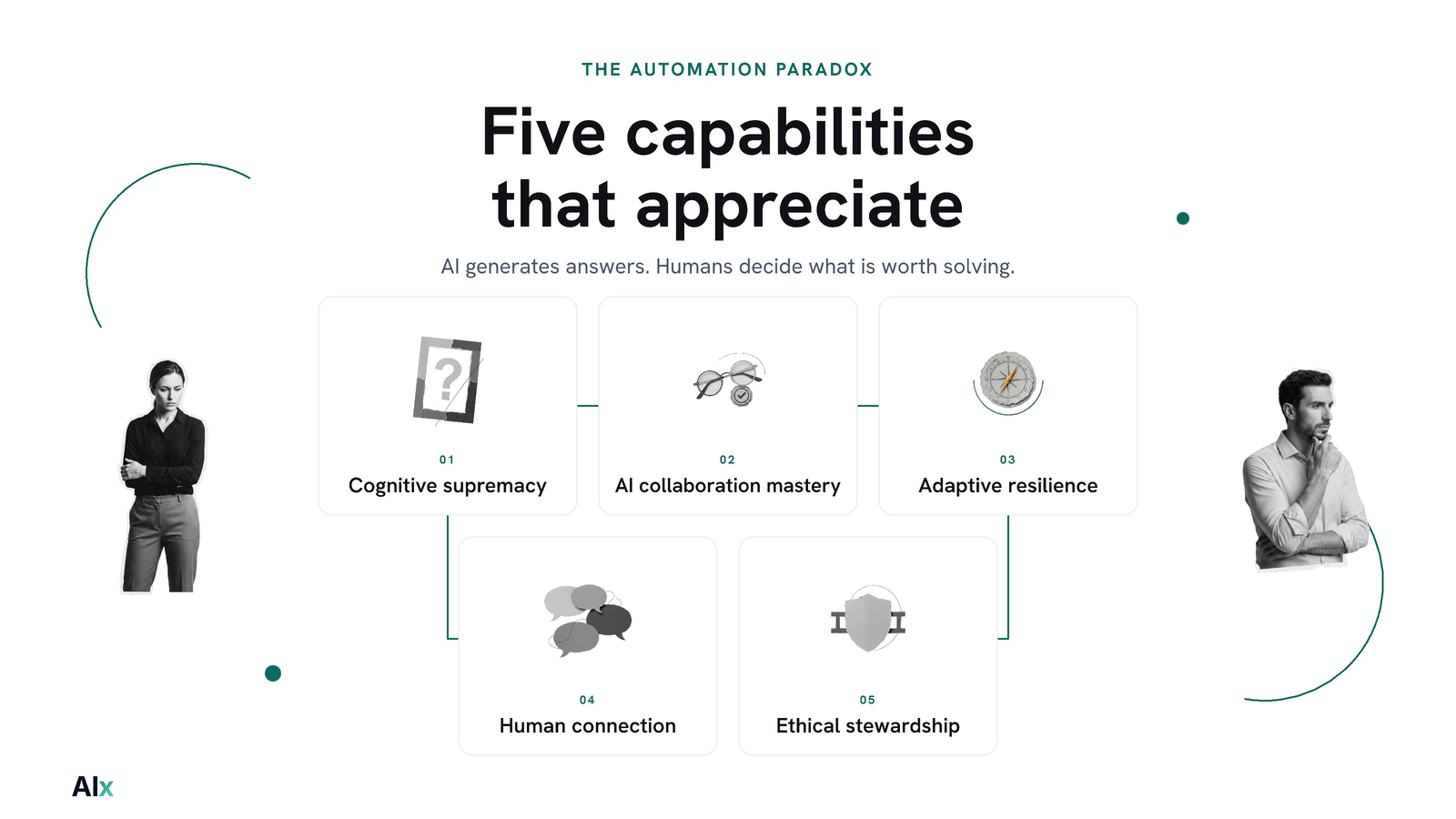
Five Capabilities That Appreciate
Across the boards and leadership teams I work with, five capability clusters separate organisations running productive AI systems from those running expensive pilots that never reach production.
1. Cognitive Supremacy
Not raw intelligence. Not credentialism. The ability to frame messy, ill-defined problems before anyone opens a model. Critical thinking, rigorous problem definition, and knowing which question, asked early, changes the entire decision. AI generates answers. It cannot decide what is worth solving.
2. AI Collaboration Mastery
Prompt engineering courses are filling training budgets, but prompting is a depreciating skill. Interface literacy changes every quarter. The durable capability is delegating to AI wisely: knowing when to trust an output, when to scrutinise it, and how to maintain rigorous verification without becoming the bottleneck. Quality control at the speed of automation.
3. Adaptive Resilience
Roles will shift faster than job descriptions can be rewritten. The useful skill is learning how to learn, turning ambiguity into an operating rhythm rather than a stall. The half-life of narrow technical specialisation is shortening. The premium is on people who can re-skill in motion.
4. Human Connection
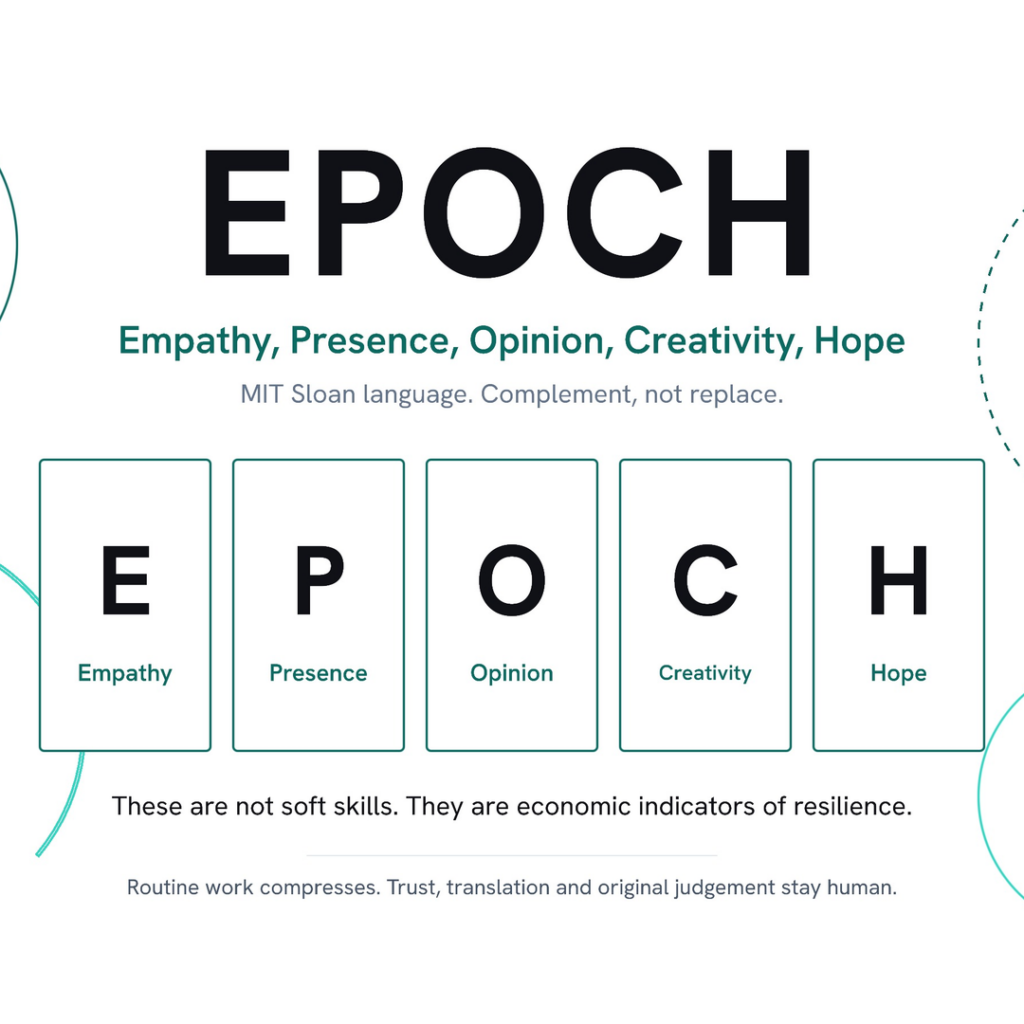
Negotiation, trust-building, reading a room, guiding a team through uncertainty when no one has the answer yet. These are not “soft” skills. They are coordination skills. AI can distribute information. It cannot align competing interests or absorb organisational tension.
5. Ethical Stewardship
Spotting bias before it scales. Protecting confidentiality when data flows through third-party models. Setting guardrails for your people, customers and data before a regulator (or a front-page incident) sets them for you.
The Pattern
Notice the economics. Every capability above gets more valuable as AI gets cheaper. If the task’s value falls as the tool’s price drops, you are not building an edge. You are leasing one.
The Cost of Ignoring This
The cost is not abstract. It is the pilot that stalls because no one in the workflow can verify whether the model’s output is sound. It is six-figure AI licence fees used to produce mediocre work faster. It is talent erosion, your strongest operators leaving because they have been reduced to prompt operators. It is compliance exposure from a decision nobody audited because everyone assumed the machine had done the thinking.
What This Means for Leaders
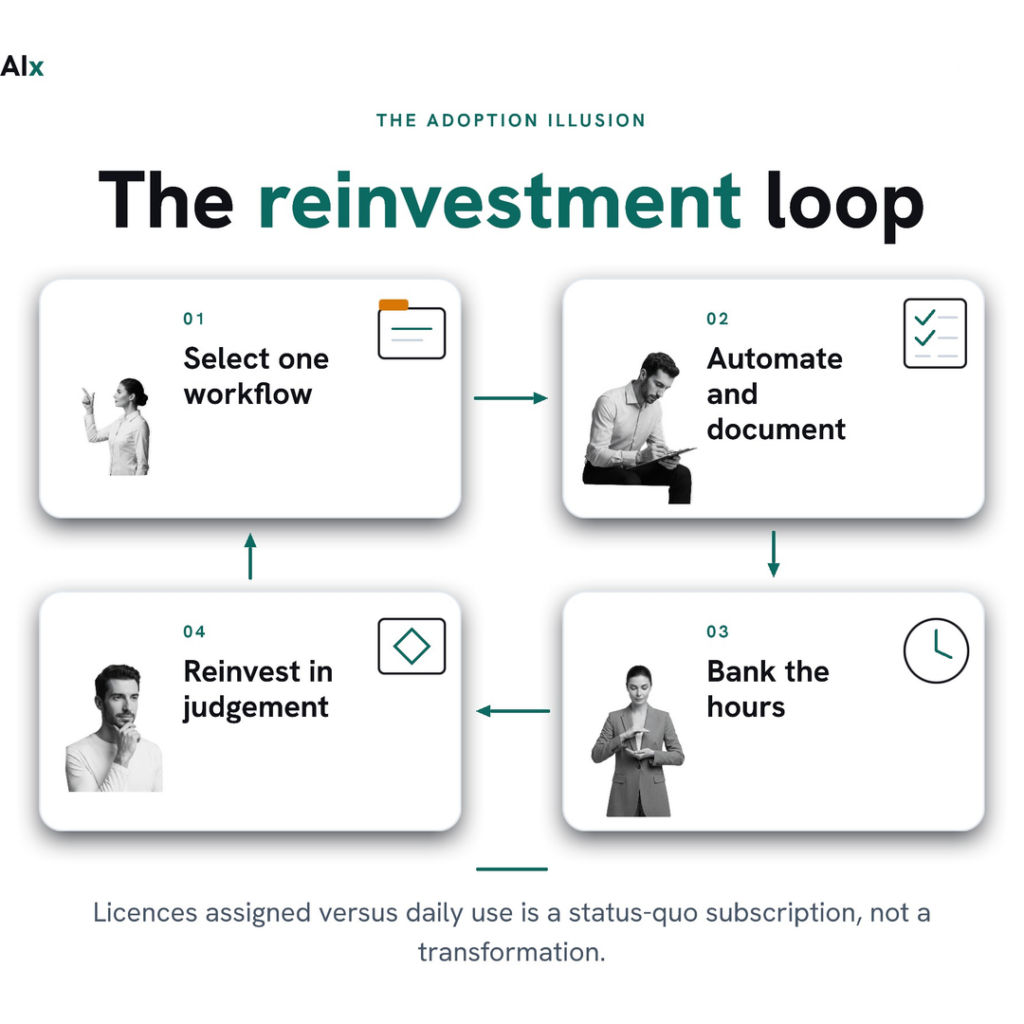
If you are a CIO, CHRO or transformation lead, your remit is shifting from technology roadmaps to capability architecture. The firms that separate themselves over the next three years will not be the ones with the most AI tools. They will be the ones who restructure workflows so AI handles the first draft and humans handle the decision; who redesign performance metrics to reward verification, not just velocity; and who treat machine collaboration as a leadership competency, not an IT training module.
That is true first in a small or mid-sized business, where one hollowed-out role is the whole verification layer. It is also true in a council, and for individuals who still own the judgement call.
The Discomfort to Sit With
Most organisations say they want AI-literate workforces. Yet they are still funding training that teaches employees to rely on the tool rather than question it. That is comfortable. It is also a dead end.
Here is the unresolved tension. Boards want fast AI ROI. Critical judgement, ethical stewardship and adaptive resilience are slow-bake capabilities. Are you willing to defend the investment in human judgement when the pressure is to automate it away?
If the answer is no, your AI spend will likely peak at the pilot stage: plenty of demos, very little durable advantage.
A Practical Next Step
If you want to map your organisation’s capability gaps against your AI adoption roadmap, Schedule a Call.