
THE HUMAN–AI INTERFACE
Same agents. Different Mondays.
Design the way you work together, before it designs you.
AI changes the work. People still need to know who decides, how to challenge an output and who owns the result. This model makes those choices visible.
3 decisions · 8 conditions · 1 energy state
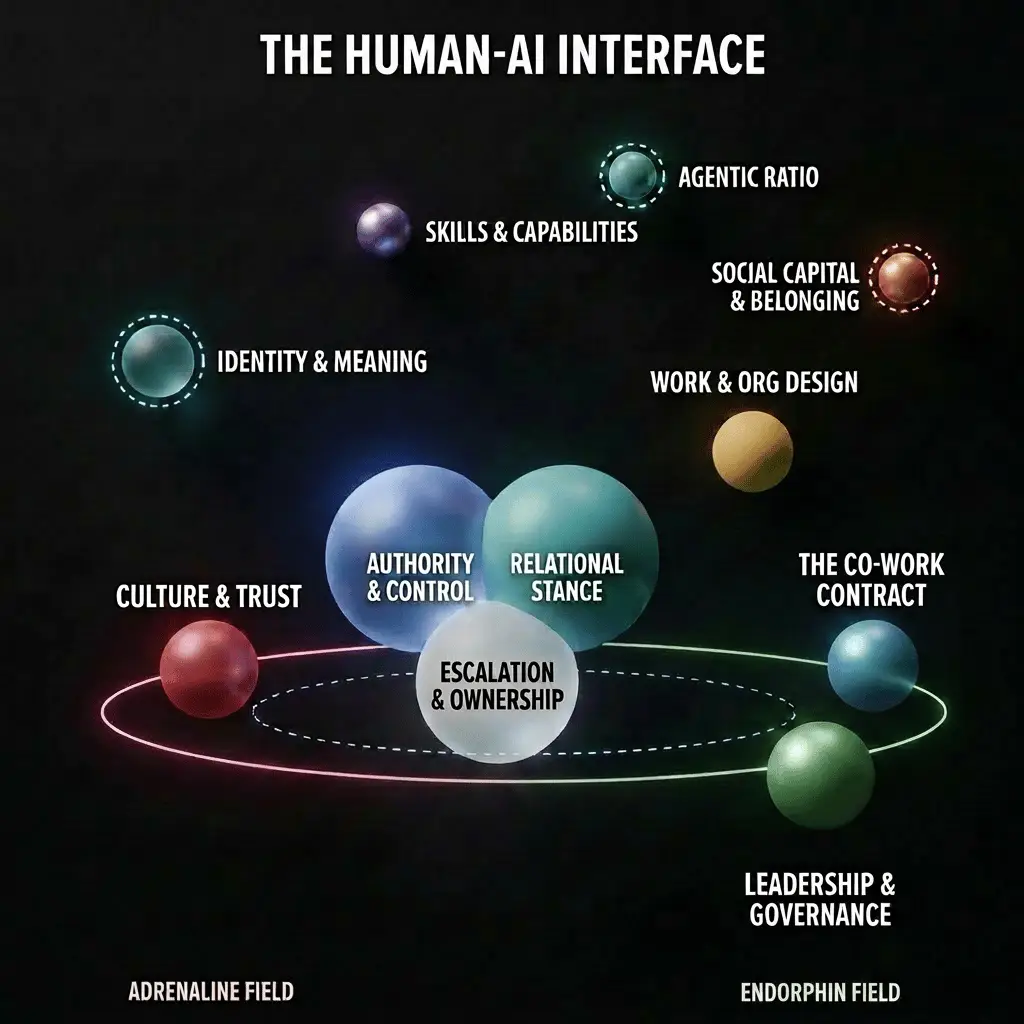
The model film. Three decisions, eight conditions and one emotional energy layer.
ILLUSTRATIVE SCENARIOS
What does AI feel like in your organisation?
The author calls this the emotional energy layer: the atmosphere that shapes whether people question, learn or stay silent. “Adrenaline” and “endorphin” are organisational metaphors, not biological measurements.
MONDAY A / ADRENALINE
Busy. Wary. Quiet.
People check outputs privately, hide their AI use and hesitate to raise concerns. Urgency and blame shape the work. The tools may function, but the agreement around them is unclear.
The signal: challenge feels risky.
MONDAY B / ENDORPHIN
Curious. Open. Accountable.
People compare notes, challenge an uncertain output and learn together. Discovery, purpose, reflection and mutual trust shape the work. Someone can intervene and owns the outcome.
The signal: concerns surface early.
THE FICTIONAL CITY OF WENLOW
When a signature stands in for control.
WENDY helps planning keep up. But planners sign more than they can check, and a concern becomes an IT ticket. The technology works; the human–AI interface has not been designed.
A signature needs time, information, authority and a usable override behind it. Wenlow and WENDY are invented for the talk, not a client case study.
THREE CENTRAL DECISIONS
Make the agreement explicit.
The co-work contract sets out how a human and agent work together. Its three decisions belong in the work, not just in a policy folder.
01
Authority & Control
Who has the final say? Choose by the stakes: approve each step, monitor and override, or set parameters and review outcomes.
02
Relational Stance
What role does the agent hold? Tool, assistant, colleague, oracle or autonomous agent. Match expectations to what the product can actually do.
03
Escalation & Ownership
What happens when you disagree? Practise the route for challenging output or reporting failure. Name the human who owns the result and its correction.
EIGHT CONDITIONS AROUND THE DECISIONS
What holds the agreement together?
01 Skills & Capabilities
Can people direct the agent and evaluate its work? Build judgement alongside prompting.
02 Identity & Meaning
As tasks change, make clear what people contribute and where their craft can grow.
03 Culture & Trust
Make it safe to show AI use, challenge an output and admit a mistake.
04 Leadership & Governance
Make decision rights visible. Leaders must practise the behaviour they ask of others.
05 Work & Organisation Design
Start with the outcome and redesign the work, handoffs and roles around it.
06 Social Capital & Belonging
Protect human relationships, shared learning and the everyday contact that builds a team.
07 Agentic Ratio
As the share of agent work rises, revisit skills, structure and safeguards. The ratio is a redesign trigger, not a target to maximise.
08 Co-work Contract
Write down how the human and agent work together. The three central decisions give this agreement its content.
PUT IT TO WORK
Bring one real pairing to the conversation.
Who decides? What role does the agent hold? What happens when you disagree? Who owns the outcome? If an answer is missing, resolve it before deploying that pairing.
Model one-pager
A concise reference to the Human–AI Interface.
Companion diagnostic
Questions to examine one pairing and identify an owned next action.
Request the one-pager
Use the existing request form to leave your name and email. The form says the one-pager will be sent once it is ready.
Request the one-pager
Leave your name and email. We will send the one-pager once it is ready.